Running Cadence: What Is a Good Steps Per Minute (SPM)?
Running cadence is your steps per minute. See what a good cadence is, where the 180 rule came from, stride length by pace, and walking cadence benchmarks.
 Steps Team•
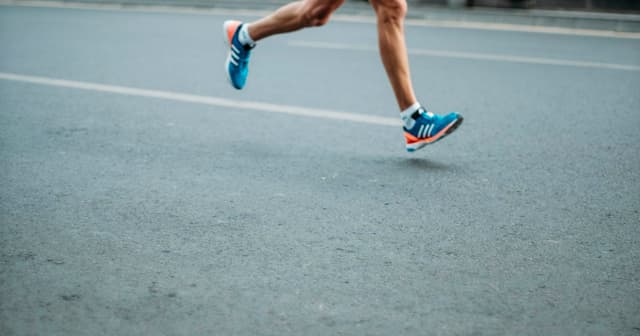
Running cadence is the number of steps you take per minute (SPM), counting both feet. Most recreational runners land somewhere around 150 to 170 steps per minute on easy runs, while elite distance runners are usually near 180 or higher at race pace. There is no single correct number: cadence rises as you run faster and tends to be lower in taller runners. If you want to raise yours, the range that has been studied is a 5 to 10% increase over your current cadence, not a jump straight to 180.
Cadence is one of the few running form numbers you can measure without a lab, and it ties directly to what a step counter tracks. This guide covers what counts as a good running cadence, where the 180 steps per minute figure came from, the stride length each cadence needs at common paces, and how walking cadence fits in.
To turn a race time or distance into a pace first, use the running pace calculator.
What Is Running Cadence?
Running cadence is your step rate: the total number of times your feet hit the ground in one minute. It is written as SPM (steps per minute). A cadence of 170 means 85 left foot strikes and 85 right foot strikes every minute.
Two notes on wording, because the terms get mixed up:
- Steps, not strides. In strict biomechanics terms, a stride is two steps (the same foot landing twice). Some research papers report strides per minute, which is half the step number: 85 strides per minute equals 170 steps per minute.
- "Stride length" on a watch usually means step length. Garmin, for example, defines stride length as the distance from one footfall to the next. This article calls that per-step distance step length. For the walking version, see average step length by height.
Cadence matters because of one equation:
Speed = cadence × step length
To run faster you take more steps per minute, longer steps, or both. And at any fixed pace, a higher cadence automatically means shorter steps.
What Is a Good Running Cadence?
A good running cadence is one that fits your speed, your height, and your experience. Here is what has actually been measured:
| Runners | Cadence (steps/min) | Source |
|---|---|---|
| Novice runners, comfortable pace | About 156 | de Ruiter et al., 2014 |
| Trained runners, comfortable pace | About 169 | de Ruiter et al., 2014 |
| Elite ultramarathoners, 100 km race | 182 average (range 155 to 203) | Burns et al., 2019 |
| Olympic runners, 800 m to marathon | 180 or more for all but one | Daniels, 1984 |
The first two rows come from a small treadmill study in the European Journal of Sport Science with 10 novice and 10 trained male runners. The paper reports strides per minute; the figures above are doubled to give steps. In the same study, the most economical cadence was a little higher than the one runners chose on their own: about 170 for the novices and about 174 for the trained runners, who were closer to their optimum.
So for most people on an easy run, 150 to 170 steps per minute is normal, and 170 to 180 is the range most often quoted as a target. A cadence in the 150s is not automatically a problem. It is worth a look if you also overstride, meaning your foot lands well out in front of your body.
Where the 180 Steps Per Minute Rule Came From
The number traces back to coach and exercise physiologist Jack Daniels. At the 1984 Los Angeles Olympics, he and his wife counted the step rates of about 47 athletes in events from the 800 m to the marathon. By Daniels' own account, which he also describes in Daniels' Running Formula, only one of them took fewer than 180 steps per minute.
Three things got lost when that observation turned into a rule:
- These were Olympians racing. A 10:00 mile is a very different task from a 4:30 mile.
- 180 was a floor for that group, not a target for everyone. Nearly all of the athletes were at or above it.
- Even elites vary widely. A 2019 study in the Journal of Applied Physiology tracked 20 competitors at the 100 km World Championship. Their average was 182 steps per minute, but individuals ranged from 155 to 203.
What Changes Your Cadence
- Speed. In the 100 km study, cadence rose by about 5.6 steps per minute for every extra meter per second of speed. That is roughly the gap between a 10:00 mile and a 7:17 mile.
- Height. Taller runners had lower cadences: about 3 steps per minute lower for each extra inch of height, or roughly 12 per 10 cm.
- Experience. Trained runners tend to choose a higher cadence than novices, as the table above shows.
Speed matters less than you might expect, though. Daniels reported that a group of elite runners averaged 184, 186, and 190 steps per minute at 7:00, 6:00, and 5:00 per mile. Their speed went up 40% while cadence went up about 3%. Almost all of the extra speed came from longer steps.
Running Cadence and Stride Length by Pace
Because speed = cadence × step length, you can work out exactly how long each step has to be for any pace and cadence. The table shows the step length needed at 160, 170, and 180 SPM.
| Pace per mile | Pace per km | Speed | 160 SPM | 170 SPM | 180 SPM |
|---|---|---|---|---|---|
| 12:00 | 7:27 | 5.0 mph / 8.0 km/h | 0.84 m (33 in) | 0.79 m (31 in) | 0.75 m (29 in) |
| 11:00 | 6:50 | 5.5 mph / 8.8 km/h | 0.91 m (36 in) | 0.86 m (34 in) | 0.81 m (32 in) |
| 10:00 | 6:13 | 6.0 mph / 9.7 km/h | 1.01 m (40 in) | 0.95 m (37 in) | 0.89 m (35 in) |
| 9:00 | 5:36 | 6.7 mph / 10.7 km/h | 1.12 m (44 in) | 1.05 m (41 in) | 0.99 m (39 in) |
| 8:00 | 4:58 | 7.5 mph / 12.1 km/h | 1.26 m (50 in) | 1.18 m (47 in) | 1.12 m (44 in) |
| 7:00 | 4:21 | 8.6 mph / 13.8 km/h | 1.44 m (57 in) | 1.35 m (53 in) | 1.28 m (50 in) |
| 6:00 | 3:44 | 10.0 mph / 16.1 km/h | 1.68 m (66 in) | 1.58 m (62 in) | 1.49 m (59 in) |
Two things stand out. At a 10:00 mile, going from 160 to 170 SPM shortens each step by about 6 cm (a little over 2 inches). And holding 180 SPM at a 12:00 mile needs a 0.75 m step, about the length of a long walking step, which is why forcing 180 on a slow jog feels like shuffling.
To convert any pace in this table to mph or km/h, use the pace to speed converter.
Average Running Stride Length
There is no single average running stride length, because it scales with speed. But the average running speed for recreational runners is about 6 mph, a 10:00 mile. At a typical cadence of 160 to 170, that gives a step length of about 0.95 to 1.0 m (37 to 40 inches). Counted as a full stride of two steps, that is about 1.9 to 2.0 m (6.2 to 6.6 ft).
For comparison, the average adult walking step is about 28 inches, so an easy running step is roughly 30 to 40% longer.
To find your own number, divide distance by steps. If you run 5 km in 30 minutes at 166 SPM, you take 4,980 steps, and 5,000 m ÷ 4,980 steps is about 1.0 m per step.
Steps Per Mile and Per Km at Each Cadence
Cadence also tells you how many steps a run adds to your day:
Steps per mile = cadence × pace (minutes per mile)
| Pace per mile (per km) | 160 SPM | 170 SPM | 180 SPM |
|---|---|---|---|
| 12:00 (7:27) | 1,920 per mile / 1,193 per km | 2,040 / 1,268 | 2,160 / 1,342 |
| 10:00 (6:13) | 1,600 / 994 | 1,700 / 1,056 | 1,800 / 1,118 |
| 9:00 (5:36) | 1,440 / 895 | 1,530 / 951 | 1,620 / 1,007 |
| 8:00 (4:58) | 1,280 / 795 | 1,360 / 845 | 1,440 / 895 |
| 7:00 (4:21) | 1,120 / 696 | 1,190 / 739 | 1,260 / 783 |
| 6:00 (3:44) | 960 / 597 | 1,020 / 634 | 1,080 / 671 |
At everyday paces of 9:00 to 12:00 per mile, that puts most runners between about 1,400 and 2,000 steps per mile. Faster running means fewer steps per mile, because step length grows much more than cadence does. Our guide to how many steps in a mile running breaks this down by height, and the steps per mile calculator gives you a personal estimate.
How to Measure Your Cadence
Count it. Warm up, settle into your normal easy pace, then count every time your right foot lands for 30 seconds and multiply by 4.
Use your watch. Most running watches, including Apple Watch and Garmin models, show cadence during a run or in the workout summary.
Work it out from steps. Divide the steps in a run by its length in minutes. A 30-minute run that adds 4,980 steps is a cadence of 166.
Your easy-run cadence and your tempo cadence will differ, so compare like with like. The training pace zones tool gives you paces to test at.
How to Increase Your Cadence Safely
The most cited evidence for changing cadence is a 2011 study in Medicine & Science in Sports & Exercise by Heiderscheit and colleagues. They had 45 healthy recreational runners run on a treadmill at a constant speed, at their preferred step rate and at 5% and 10% above and below it.
- At 5% and 10% higher step rates, the knee absorbed less energy.
- At 10% higher, the hip absorbed less energy too.
- Step length, vertical bounce, and braking impulse all decreased.
- At a step rate 10% lower, every joint absorbed more energy.
One caveat: the study measured joint loading in healthy runners in a lab. It did not track injuries, so treat a cadence change as a way to reduce load, not a guarantee against getting hurt.
A sensible way to do it:
- Find your baseline at an easy pace.
- Add 5%. Use the table below.
- Set a metronome app or a playlist to that BPM and match your steps to the beat.
- Keep your pace the same. The goal is shorter, quicker steps, not faster running.
- Start with short blocks, such as one minute at the new cadence every few minutes of an easy run, and extend them over several weeks.
- Only go to 10% if 5% feels natural and you still have a reason to change.
| Current cadence | +5% | +10% |
|---|---|---|
| 150 | 158 | 165 |
| 160 | 168 | 176 |
| 170 | 179 | 187 |
Heart rate is a useful check. The de Ruiter study concluded that heart rate can be used to find your most economical cadence: at a fixed pace, the cadence that gives the lowest heart rate is close to your optimum. Knowing your max heart rate by age helps you keep these test runs easy.
Cadence is a form metric, not a fitness metric. Fitness shows up in numbers like your VO2 max and your resting heart rate.
Walking Cadence: Steps Per Minute Benchmarks
Cadence is just as useful for walking. In the CADENCE-Adults study, Catrine Tudor-Locke and colleagues had 76 adults aged 21 to 40 walk on a treadmill while their oxygen use was measured and their steps were counted by hand. Two round numbers came out:
| Walking cadence | Intensity | Steps in 30 minutes |
|---|---|---|
| Under 100 steps/min | Light | Under 3,000 |
| 100 steps/min | Moderate (3 METs) | 3,000 |
| 130 steps/min | Vigorous (6 METs) | 3,900 |
A follow-up with 80 adults aged 41 to 60 found the same 100 and 130 thresholds. In adults aged 61 to 85, 100 steps per minute still marked moderate intensity, with 110 and 120 steps per minute lining up with 4 and 5 METs. Too few older adults reached 6 METs to set a vigorous threshold for that age group.
This fits walking speed data: a typical 3 to 4 mph walk works out to roughly 100 to 130 steps per minute (see average walking pace for speeds by age). The practical rule: if you are walking at 100 steps per minute or more, it generally counts as moderate exercise.
How Cadence Adds Up in Your Daily Step Count
Steps are cadence multiplied by minutes, so cadence tells you what any walk or run is worth:
| Activity | 10 min | 20 min | 30 min | 60 min |
|---|---|---|---|---|
| Walk at 100 SPM | 1,000 | 2,000 | 3,000 | 6,000 |
| Walk at 120 SPM | 1,200 | 2,400 | 3,600 | 7,200 |
| Run at 160 SPM | 1,600 | 3,200 | 4,800 | 9,600 |
| Run at 170 SPM | 1,700 | 3,400 | 5,100 | 10,200 |
| Run at 180 SPM | 1,800 | 3,600 | 5,400 | 10,800 |
Per minute, running adds more steps than walking: a 30-minute run at 160 SPM is about 4,800 steps against 3,000 for a moderate walk. Per mile it is the other way around, because running steps are longer. To turn any step total into miles or kilometers, use the step distance calculator.
Frequently Asked Questions
What is a good running cadence?
For most recreational runners, 150 to 170 steps per minute on easy runs is normal, rising toward 170 to 180 or more at faster paces. It depends on speed and height, so there is no single ideal number. If you do change it, raise it by 5 to 10% at most.
Is 180 steps per minute the ideal running cadence?
No. The 180 figure comes from Jack Daniels counting Olympic runners in 1984, almost all of whom were at 180 or above while racing. Later research on elite ultramarathoners found an average of 182 but a range of 155 to 203. It describes fast runners at race pace, not a target for everyone.
What is the average running stride length?
It depends on speed. At a 10:00 mile and a cadence of 160 to 170 steps per minute, each step is about 0.95 to 1.0 m (37 to 40 inches), or about 1.9 to 2.0 m per two-step stride. Faster paces need longer steps.
How do I calculate stride length from cadence?
Divide your speed in meters per minute by your cadence. At 6 mph you cover about 161 m per minute, so at 165 SPM each step is 161 ÷ 165, or about 0.98 m.
What is a good walking cadence?
About 100 steps per minute or more. In the CADENCE-Adults studies, 100 steps per minute marked moderate intensity for adults of all ages tested, and 130 steps per minute marked vigorous intensity for adults aged 21 to 60.
Does a higher cadence make you faster?
Not by itself. Speed is cadence times step length, so a higher cadence at the same pace just means shorter steps. Elite runners speed up mostly by lengthening their steps, with cadence rising only a few percent.
Track Your Steps Per Minute, Mile, and Day
Running cadence tells you how your speed is split between step rate and step length. Measure yours at an easy pace, compare it with the tables above, and only change it if you have a reason to, 5% at a time.
- Running pace calculator to find your pace for any distance and time
- Steps per mile calculator to see how your steps add up by height and pace
Steps: Workout & Pedometer counts every walking and running step automatically on your iPhone and Apple Watch, so you can see what each run adds to your day.
Ready to see how your steps add up? Download Steps
You Might Also Like
Try Our Calculators
Steps is built by runners who wanted a step counter that felt right. Read our story