Are Treadmill Calories Accurate? What the Research Shows
Are treadmill calories accurate? Most consoles overestimate by roughly 10-20%. Here's why, how watches compare, and how to get a number you can trust.
 Steps Team•
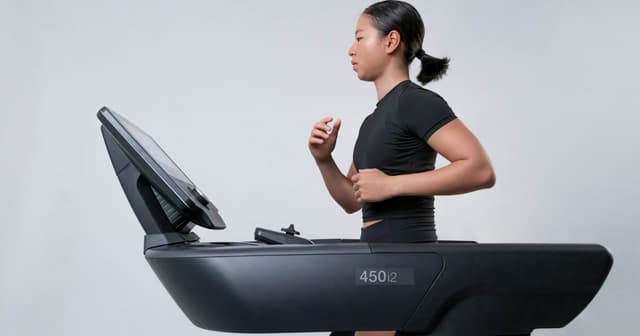
Are treadmill calories accurate? Only roughly. In a widely reported University of California, San Francisco test, treadmills overestimated calorie burn by about 13% compared with lab measurement of oxygen use, and the number on your console can be off by more if you skip entering your weight, hold the handrails, or forget that it counts the calories you'd have burned sitting still. Treat the display as a ballpark, not a measurement.
The good news is that most of the error comes from a handful of fixable things. This guide covers what the research actually says about treadmill calorie accuracy, the five reasons the number drifts, how an Apple Watch or Fitbit compares, and a simple way to get a figure you can use for weight loss. If you just want to know how many calories a treadmill workout burns at a given speed and incline, our calories burned on treadmill guide has the full tables. This post is about whether you can trust the number.
Are Treadmill Calories Accurate? The Short Answer
Treadmills are among the more accurate cardio machines, because walking and running on a moving belt is easy to model. Speed and incline tell the machine almost exactly how much work you're doing, which is not true of an elliptical or a rowing machine.
Even so, the displayed number usually runs high. The best-known comparison is a 2010 test at UCSF's Human Performance Center, reported by Good Morning America and other outlets, which checked machine readouts against a VO2 analyzer (the lab standard that measures the oxygen you breathe):
| Machine | Overestimate vs. Lab Measurement |
|---|---|
| Treadmill | 13% |
| Stair climber | 12% |
| Stationary bike | 7% |
| Elliptical | 42% |
| Average across machines | 19% |
Two caveats. First, that test was a media experiment, not a peer-reviewed paper, so take the exact percentages loosely. Second, it measured machines used correctly. Real-world habits, like leaning on the rails or never entering your weight, stack more error on top.
A fair summary: a treadmill calorie counter is usually within about 10-20% of reality when you've entered your weight and walk hands-free, and it can be off by 25% or more when you haven't.
How Treadmills Calculate Calories
Almost every treadmill console runs a version of the same physics. It takes your speed and incline, estimates how much oxygen that effort costs per kilogram of body weight, then multiplies by your weight to get calories.
The standard version is the American College of Sports Medicine (ACSM) metabolic equation, the same one our treadmill calorie calculator uses:
Walking VO2 = (0.1 x speed) + (1.8 x speed x grade) + 3.5
Running VO2 = (0.2 x speed) + (0.9 x speed x grade) + 3.5
Speed is in meters per minute, grade is the incline as a decimal (5% = 0.05), and VO2 comes out in ml of oxygen per kg per minute. Every liter of oxygen you use is worth about 5 calories.
Notice the + 3.5 at the end of both formulas. That's your resting metabolism, which leads to the biggest reason treadmill numbers feel inflated.
Why Treadmills Overestimate Calories: 5 Common Causes
1. Gross Calories vs. Net Calories
The 3.5 in the ACSM formula is one MET, the oxygen your body uses at complete rest. Because it's baked in, the console shows gross calories: everything you burned during the session, including the calories you would have burned anyway sitting on the couch.
What matters for weight loss is net calories, the extra energy the workout cost. Resting burn is already counted in your daily maintenance number (your BMR and TDEE; see BMR vs. TDEE if those terms are fuzzy). Count it again on top and you double-dip.
The slower you walk, the bigger the gap. For a 160 lb person walking 30 minutes:
| Treadmill Setting | Gross (Console-Style) | Resting Portion | Net (Extra Burn) | Share That's Resting |
|---|---|---|---|---|
| 2.0 mph, 0% | 97 cal | 38 cal | 58 cal | 39% |
| 3.0 mph, 0% | 126 cal | 38 cal | 88 cal | 30% |
| 3.5 mph, 0% | 140 cal | 38 cal | 102 cal | 27% |
| 3.5 mph, 5% | 232 cal | 38 cal | 194 cal | 16% |
| 3.5 mph, 10% | 324 cal | 38 cal | 286 cal | 12% |
| 6.0 mph, 0% (run) | 389 cal | 38 cal | 351 cal | 10% |
Calculated with the ACSM equations at 72.6 kg (160 lb).
At an easy stroll, close to 40% of the number on the screen is calories you'd have burned anyway. Add incline or speed and that share shrinks, which is one reason incline walking is such an efficient way to raise your net burn.
2. The Default Body Weight
Calorie burn in these formulas scales directly with body weight. If you hit Quick Start without entering yours, the machine plugs in a default. Owner's manuals for Precor, Spirit, and Matrix treadmills list 150 lb (68 kg) as the default; at least one Star Trac model uses 155 lb.
That means the error depends entirely on how far you are from the default:
| Your Actual Weight | Machine Assumes | Display Error |
|---|---|---|
| 120 lb | 150 lb | 25% too high |
| 150 lb | 150 lb | About right |
| 180 lb | 150 lb | 17% too low |
| 220 lb | 150 lb | 32% too low |
So treadmills don't always overestimate. If you weigh more than the default and skip the weight entry, the console likely shows fewer calories than you burned. Lighter users get flattered.
3. Holding the Handrails
Gripping the rails lets your arms carry part of your body weight and, on an incline, lets you lean back against the slope. The machine has no idea. It still credits you for walking up a 10% grade unsupported.
Studies put the size of this effect anywhere from a few percent to well over 15%:
- An Ohio State study of women on stepping machines found that even light handrail support cut oxygen use by about 7-8% at a slower stepping rate.
- A study of incline treadmill walking found that holding the rails while leaning backward significantly reduced metabolic cost, while holding them and staying upright did not.
- A 2023 Brazilian study of treadmill exercise testing found that holding the rails reduced cardiorespiratory and metabolic responses by more than 15%.
If you need the rails for balance, a light fingertip touch is fine. A firm grip and a backward lean is where the calorie count stops meaning much.
4. It Ignores Your Fitness and Body Shape
The equation assumes everyone moving at 3.5 mph spends the same oxygen per kilogram. In reality, walking economy varies with height, leg length, technique, and training. A trained walker or runner moves more efficiently and burns somewhat fewer calories at the same speed than a beginner.
Research cuts both ways here. A 2016 Southern Methodist University analysis in the Journal of Applied Physiology (Ludlow and Weyand) found the ACSM equation underestimated level-ground walking costs in the large majority of published data sets, partly because the original equations were built on a small group of average-height men. On the other hand, smaller studies in college women and in adults with obesity have found the same equation overestimates on steeper grades and at harder efforts. The equation is a reasonable average, but your personal error could land on either side.
5. Generic MET Formulas and Brand Differences
Not every console uses the textbook ACSM equation. Some brands use MET tables, some use their own proprietary formulas, and some add heart rate from a chest strap or hand grips. That's why two treadmills set to the same speed and incline can show different numbers. None of them is measuring you; they're all estimating from the same few inputs.
Treadmill vs. Apple Watch vs. Fitbit: Which Is More Accurate?
If you've ever finished a workout with your watch and the treadmill showing different numbers, you've probably wondered which to believe. Here's what the best studies show for wrist devices:
- Stanford, 2017. Shcherbina and colleagues tested seven wrist-worn devices, including the Apple Watch and Fitbit Surge, against lab measurement in 60 volunteers. Heart rate was generally accurate, but no device measured energy expenditure with less than 20% error. Median error ranged from about 27% for the most accurate device to 93% for the least. Errors were highest during walking.
- University of Mississippi, 2025. A meta-analysis of 56 studies on the Apple Watch found mean absolute errors of about 4% for heart rate and 8% for steps, but about 28% for energy expenditure. Newer models did somewhat better.
So which is closer? On a treadmill specifically, the machine has a real advantage: it knows your exact speed and incline, while your watch has to infer them from wrist motion and heart rate. A treadmill with your correct weight entered, used hands-free, is often at least as trustworthy as a watch for that session.
| Method | Typical Error | Main Weakness |
|---|---|---|
| Lab measurement (VO2 analyzer) | Reference standard | Not available at the gym |
| Treadmill console, weight entered | Roughly 10-20% | Gross calories, rails, generic formula |
| Treadmill console, default weight | Can exceed 25% | Wrong weight scales every number |
| ACSM equation with your weight | Similar to a good console | Ignores individual efficiency |
| Wrist wearables (Apple Watch, Fitbit) | About 20-30% average | Guesses effort from wrist and heart rate |
One important difference: the Apple Watch splits Active Calories from Total Calories. Active Calories is designed to leave out your resting burn, so it's closer to a net number, while the treadmill console usually shows gross. That alone can explain much of a gap between the two screens, even if neither is badly wrong.
How to Get an Accurate Treadmill Calorie Number
You can't get lab precision without a lab, but these steps remove most of the avoidable error:
- Always enter your weight. It's the single biggest correctable input. Update it as your weight changes.
- Walk hands-free. Lower the speed or incline until you can let go. Your real burn at 3.2 mph unsupported beats a fake burn at 3.8 mph hanging on.
- Subtract your resting calories. For a net figure, take away roughly one MET: about 1.2 calories per minute at 150 lb, 1.4 at 180 lb, or 1.7 at 210 lb. Use the Mifflin-St Jeor equation if you want your personal resting rate.
- Run the formula yourself. Plug your weight, speed, incline, and time into the treadmill calorie calculator for an ACSM-based estimate that doesn't depend on your machine's brand.
- Compare like with like. Match your watch's Active Calories against the net treadmill figure, not the gross one.
- Trust trends over single numbers. Even an imperfect estimate is useful if you compare it with itself week to week.
If you want to see how much each percent of grade adds, the treadmill incline calculator shows the equivalent effort and calorie cost of different incline settings.
Worked Example: Net vs. Gross Treadmill Calories
Say you weigh 160 lb and walk 30 minutes at 3.5 mph on a 5% incline.
Step 1: Gross calories (what the console is modeling). The ACSM walking equation gives about 21.3 ml of oxygen per kg per minute. At 72.6 kg that's about 7.7 calories per minute, or 232 calories for 30 minutes.
Step 2: Resting calories. One MET at your weight is about 1.27 calories per minute, or 38 calories over 30 minutes.
Step 3: Net calories. 232 - 38 = 194 calories of actual extra burn.
Step 4: Factor in the console's typical bias. If your treadmill reads about 13% high, like the UCSF test found, it might show around 260 calories. That's roughly a third more than the 194 you should count toward your deficit.
Step 5: Check the rails. If you held on firmly and leaned back, knock off another chunk. Your true net burn could be closer to 160-170 calories.
Over a month of five sessions a week, the difference between logging 260 and 194 is about 1,350 calories, or roughly 0.4 pounds of fat on paper that never happened. That's exactly the kind of gap that makes people "eat back" their exercise and wonder why the scale stalls.
Frequently Asked Questions
Are treadmill calories accurate for weight loss?
They're accurate enough to track trends, but not precise enough to "eat back." Use the net figure (console calories minus about one MET of resting burn), make sure your weight is entered, and walk hands-free. Then treat the result as an estimate within roughly 10-20%.
Do treadmills overestimate calories?
Usually, yes. The UCSF test found treadmills read about 13% high, and most consoles show gross calories, which include your resting burn. The exception is when you weigh well over the default weight (often 150 lb) and don't enter yours; then the console can underestimate.
How accurate is the treadmill calorie counter compared to an Apple Watch?
For treadmill sessions specifically, a console with your correct weight is often as good as or better than a watch, because it knows your exact speed and incline. Wrist devices averaged roughly 20-30% error for calories in the Stanford and University of Mississippi research. Remember the Apple Watch's Active Calories excludes resting burn, so it typically reads lower than the treadmill.
Why does my treadmill show more calories than my Fitbit or Apple Watch?
Mostly because of gross vs. net. The treadmill counts resting calories; your watch's active number doesn't. Holding the rails, a wrong default weight, and different formulas widen the gap further.
Does holding the handrails really change calories burned?
Yes. Research shows light support can lower oxygen use by several percent, and a firm grip with a backward lean can cut it by more than 15%, especially on an incline. The treadmill doesn't know you're holding on, so it keeps crediting you for the full effort.
Is the treadmill calorie calculator more accurate than the machine?
An ACSM-based calculator gives about the same estimate a well-programmed console would, but with two advantages: it always uses your real weight, and it shows the incline effect clearly. It still can't account for your personal walking efficiency.
The Bottom Line on Treadmill Calorie Accuracy
So, are treadmill calories accurate? They're a reasonable estimate, typically within 10-20% when used properly, and noticeably worse when you skip your weight or lean on the rails. The biggest hidden inflation is that the display counts calories you'd have burned anyway. Enter your weight, let go of the rails, subtract your resting burn, and you'll have a number solid enough to plan around.
Ready to track every treadmill walk with numbers you can trust? Download Steps to log your steps, distance, and calories on the treadmill or outside, free on iPhone and Apple Watch.
You Might Also Like
Try Our Calculators
Steps is built by runners who wanted a step counter that felt right. Read our story